An outdoor deck is more than just a home improvement project; it is an extension of your living space, a venue for summer barbecues, and a quiet retreat for morning coffee. As demand for outdoor living spaces surges, homeowners across the United States are looking to add decks to their properties. However, budgeting for this addition can be tricky. While material costs are often transparent—you can see the price of lumber or composite boards on a shelf—labor costs are far more variable and can often exceed the cost of materials.
Understanding the labor cost to build a deck per square foot is essential for planning a realistic budget. If you underestimate the workforce required, your project could stall halfway through or drain your savings. This guide breaks down national averages, provides a detailed look at labor costs in every single state, and explores the variables that drive these prices up or down. Whether you are planning a simple pressure-treated wood platform or a multi-level composite masterpiece, knowing the numbers is the first step.
National Average Labor Costs
When budgeting for a deck, the general rule of thumb used to be a 50/50 split between materials and labor. However, in recent years, skilled labor shortages have pushed the labor portion higher.
On a national level, the labor cost to build a deck typically ranges from $15 to $35 per square foot.
This means for a standard 10×12 foot deck (120 square feet), you might pay anywhere from $1,800 to $4,200 just for the labor, excluding materials. Several variables skew this average, including the contractor’s experience level, insurance requirements, and overhead. It is also important to note that “labor” isn’t just swinging a hammer; it includes site preparation, digging footings, framing, laying decking, and installing railings.
State-by-State Guide: Labor Cost Per Square Foot In United States Region
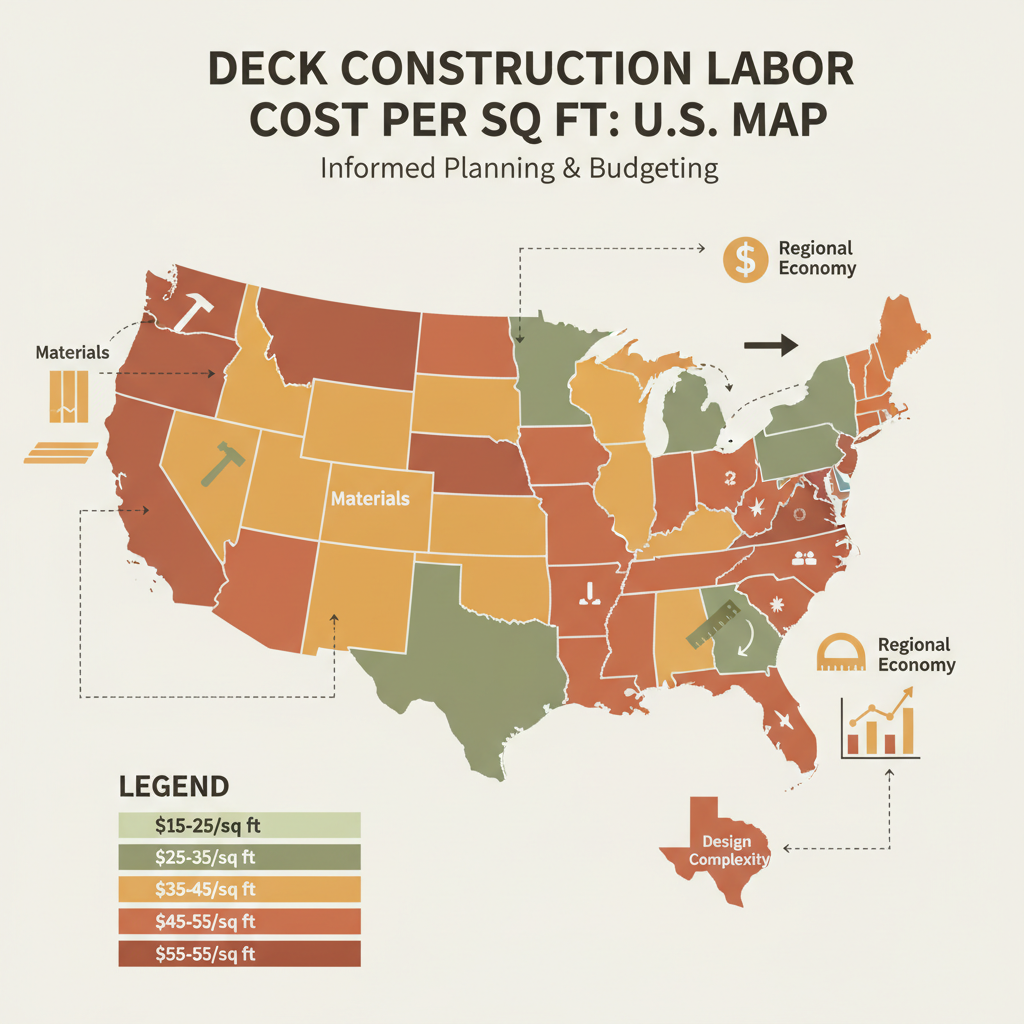
Construction labor rates are heavily tied to the local cost of living and the availability of skilled tradespeople. Below is a breakdown of estimated labor costs to build a deck per square foot for every state in the US.
Note: These are estimates for standard deck installation. Complex designs or difficult terrain will push these numbers toward the higher end of the range.
Alabama: $14 – $22 per sq. ft.
The cost of living is lower here, resulting in more affordable labor rates compared to the national average.
Alaska: $25 – $40 per sq. ft.
Due to a shorter building season and higher costs to transport equipment and crews to remote areas, Alaska commands premium rates.
Arizona: $18 – $30 per sq. ft.
Hard, rocky soil can make digging footings difficult, often increasing the labor hours required for the foundation.
Arkansas: $14 – $20 per sq. ft.
Labor rates remain competitive here, making deck building relatively affordable compared to neighboring states.
California: $30 – $55+ per sq. ft.
High demand, strict seismic codes, and a high cost of living make California one of the most expensive states for construction labor.
Colorado: $22 – $38 per sq. ft.
Rocky terrain and strict codes regarding snow loads can increase the labor intensity for structural support.
Connecticut: $25 – $42 per sq. ft.
As part of the expensive Northeast corridor, skilled carpentry labor comes at a premium here.
Delaware: $22 – $35 per sq. ft.
Rates are moderately high, influenced by the proximity to major metropolitan hubs like Philadelphia.
Florida: $18 – $32 per sq. ft.
While labor is available, strict hurricane codes require deeper footings and specific framing techniques, adding to labor time.
Georgia: $16 – $28 per sq. ft.
A strong construction market keeps prices competitive, though rates in Atlanta will be significantly higher than rural areas.
Hawaii: $35 – $55 per sq. ft.
The highest cost of living in the nation and the need to import equipment result in very high labor costs.
Idaho: $18 – $30 per sq. ft.
A booming housing market has increased demand for contractors, slowly driving up labor rates in recent years.
Illinois: $24 – $40 per sq. ft.
Union strength and higher costs of living in the Chicago area skew the state average upward.
Indiana: $16 – $26 per sq. ft.
Generally affordable labor rates, though pricing increases near Indianapolis.
Iowa: $16 – $26 per sq. ft.
Consistent, moderate pricing for carpentry labor throughout the state.
Kansas: $16 – $25 per sq. ft.
Similar to Iowa, costs are generally lower than the national average due to a lower cost of living.
Kentucky: $15 – $24 per sq. ft.
One of the more affordable states for construction labor.
Louisiana: $16 – $26 per sq. ft.
High humidity and water tables may require specific foundation work, but general labor rates remain moderate.
Maine: $20 – $32 per sq. ft.
A shorter building season can create high demand during summer months, pushing prices up.
Maryland: $24 – $38 per sq. ft.
Proximity to D.C. keeps labor rates high, and strict local codes require knowledgeable (and expensive) professionals.
Massachusetts: $30 – $50 per sq. ft.
High cost of living and a shortage of skilled tradespeople make this one of the priciest states for deck building.
Michigan: $18 – $30 per sq. ft.
Frost line requirements mean deeper footings, which adds labor time to the foundation phase.
Minnesota: $20 – $34 per sq. ft.
Like Michigan, deep frost lines and a short season create higher labor demand and costs.
Mississippi: $13 – $20 per sq. ft.
Typically offers some of the lowest construction labor rates in the country.
Missouri: $16 – $26 per sq. ft.
Rates are generally affordable, though they rise in the St. Louis and Kansas City metros.
Montana: $20 – $32 per sq. ft.
Large travel distances for contractors can add travel surcharges to the labor rate.
Nebraska: $16 – $26 per sq. ft.
Standard Midwestern pricing applies, with relatively stable labor markets.
Nevada: $20 – $35 per sq. ft.
Las Vegas demand drives prices, and digging in desert caliche soil is labor-intensive.
New Hampshire: $22 – $35 per sq. ft.
Sharing the high costs of the New England region, though slightly lower than Massachusetts.
New Jersey: $28 – $45 per sq. ft.
High taxes, insurance costs, and density drive labor rates well above the national average.
New Mexico: $16 – $26 per sq. ft.
generally affordable, though specialized foundation work for sandy soil can vary the price.
New York: $30 – $55+ per sq. ft.
Upstate rates are moderate, but NYC and Long Island rates are among the highest in the country.
North Carolina: $16 – $28 per sq. ft.
A popular state for deck building due to weather; competitive markets keep prices reasonable.
North Dakota: $20 – $32 per sq. ft.
Oil booms occasionally affect labor availability, and the short building season keeps rates firm.
Ohio: $17 – $28 per sq. ft.
A solid mix of urban and rural pricing results in a moderate state average.
Oklahoma: $14 – $22 per sq. ft.
Very affordable labor market for residential construction.
Oregon: $25 – $40 per sq. ft.
High demand for sustainable building practices and a higher cost of living drive rates up.
Pennsylvania: $20 – $35 per sq. ft.
Varies wildly between Philadelphia/Pittsburgh (high) and rural areas (moderate).
Rhode Island: $26 – $42 per sq. ft.
Small state with high demand and limited contractor availability keeps prices high.
South Carolina: $16 – $26 per sq. ft.
Generally affordable, though coastal areas with specific wind codes may cost more.
South Dakota: $17 – $27 per sq. ft.
Moderate pricing consistent with the upper Midwest.
Tennessee: $15 – $25 per sq. ft.
No state income tax and a lower cost of living help keep labor prices down.
Texas: $16 – $30 per sq. ft.
Huge variations; Austin and Dallas are expensive, while rural areas are very affordable.
Utah: $20 – $32 per sq. ft.
A rapidly growing housing market has strained labor availability, pushing prices up.
Vermont: $22 – $35 per sq. ft.
Emphasis on quality craftsmanship and a short season keeps labor rates elevated.
Virginia: $20 – $35 per sq. ft.
Northern Virginia (NOVA) is very expensive, while the rest of the state is moderate.
Washington: $30 – $50 per sq. ft.
Seattle’s tech boom has inflated all service costs, including construction labor.
West Virginia: $15 – $24 per sq. ft.
One of the most affordable states for carpentry labor.
Wisconsin: $18 – $30 per sq. ft.
Short seasons and frost line requirements dictate the pricing structure here.
Wyoming: $18 – $30 per sq. ft.
Travel time for crews to reach rural properties often gets factored into the labor quote.
Regional Cost Variations
Looking at the state breakdown, clear patterns emerge.
- The Northeast & West Coast: These are the most expensive regions. High property values, strong unions, strict building codes, and general cost of living contribute to labor rates often exceeding $40 per square foot.
- The South & Midwest: These regions offer the most value. With lower costs of living and generally easier excavation conditions (excluding rocky areas), homeowners here typically pay between $15 and $25 per square foot for labor.
- Mountain West: This area is seeing the fastest price growth. As populations boom in Idaho, Utah, and Colorado, the supply of contractors hasn’t kept up with demand, leading to rising labor costs.
Factors Affecting Labor Costs
Why does one neighbor pay $20 per square foot while another pays $40? The square footage is just the starting point.
Site Accessibility and Condition
If your backyard is flat and accessible by a truck, labor costs drop. If contractors have to hand-carry lumber up a steep hill or excavate rocky soil by hand because machinery won’t fit through the gate, you pay for that extra time and effort.
Deck Complexity and Height
A rectangular deck close to the ground is the cheapest to build. Once you add curves, multiple levels, or significant height (requiring scaffolding and larger support posts), the required skill level and time increase. Building a second-story deck takes significantly longer than a ground-level platform due to the logistics of lifting materials and ensuring safety.
Material Hardness
Labor isn’t just about the human; it’s about the material. Pressure-treated pine is soft and easy to cut. Exotic hardwoods like Ipe or heavy composite boards are difficult to work with. They require special saw blades, pre-drilling for screws, and heavy lifting. Contractors often charge a premium for labor when working with high-end materials because the installation is slower.
Demolition
Does an old deck need to be removed first? Demolition is a separate labor cost. ripping out old boards, digging up old concrete footings, and hauling away debris can add $5 to $10 per square foot to the project.
DIY vs. Professional Installation
With labor costs rising, the temptation to build it yourself is strong.
The DIY Route:
- Pros: You save thousands of dollars. You have total control over the pace.
- Cons: It is physically grueling work. You are responsible for permits and inspections. If you make a structural mistake, it can be dangerous and expensive to fix. You also lack a warranty.
Hiring a Professional:
- Pros: Speed and efficiency. A pro crew can finish in a week what might take you all summer. They understand local codes, frost lines, and load-bearing requirements. Most reputable contractors offer workmanship warranties.
- Cons: Significantly higher upfront cost.
For a simple, low-to-the-ground platform, a handy homeowner might succeed. For elevated decks, multi-level designs, or ledger attachments to the house, professional installation is strongly recommended for safety.
How to Get Accurate Estimates
Never rely on a verbal “guesstimate.” To understand exactly what your labor costs will be:
- Get Three Quotes: This allows you to identify outliers. If one quote is 40% lower than the rest, they might be cutting corners or missing insurance.
- Ask for a Breakdown: Ask the contractor to separate material and labor in the quote. This shows you exactly what you are paying for their time.
- Site Visits are Mandatory: A contractor cannot give you an accurate labor quote over the phone. They need to see the soil, the slope, and the attachment points on the house.
Finding Reliable Contractors
Finding a builder is easy; finding a good builder is hard. Start by checking online reviews, but don’t stop there. Ask for proof of general liability insurance and workers’ compensation. If a worker gets hurt on your property and the contractor isn’t insured, you could be liable.
Cost-Saving Strategies
If the labor quotes are coming in too high, try these adjustments:
- Simplify the Design: Eliminate curves and 45-degree angles. Stick to standard lumber lengths (10, 12, 16 feet) to minimize cutting and waste.
- Build in the Off-Season: Contractors are busiest in spring and summer. If you schedule your build for late autumn or early winter (weather permitting), you may negotiate a lower labor rate to keep their crew busy.
- Handle Demolition Yourself: If you are physically able, tearing down the old deck yourself and having the site ready for the builders can save you hundreds in labor fees.
Long-Term Cost Considerations
A cheap deck now can be an expensive deck later. While professional labor costs more upfront, a poorly installed deck can lead to water damage on your home’s rim joist, sagging structures, or loose railings.
Furthermore, consider the maintenance labor. If you pay less for labor to install wood but have to stain it every two years, you are incurring a recurring labor cost (either your own time or hiring a painter). Paying more for the labor to install composite decking means you largely eliminate maintenance labor for the next 20 years.
Case Studies: Real-World Examples
Case Study 1: The Budget Build in Ohio
- Project: 12×12 pressure-treated pine deck, ground level.
- Labor Rate: $20/sq. ft.
- Total Labor: $2,880.
- Outcome: Simple design and easy access kept labor costs low.
Case Study 2: The Hillside Haven in California
- Project: 400 sq. ft. multi-level composite deck on a steep slope.
- Labor Rate: $55/sq. ft.
- Total Labor: $22,000.
- Outcome: The steep slope required deep concrete piers and extensive scaffolding, driving the labor cost significantly higher than the materials.
Conclusion
Building a deck is a significant financial commitment, but it yields high returns in terms of lifestyle and property value. While material prices get a lot of attention, the labor cost to build a deck per square foot is the variable that requires the most scrutiny. From $14 in Mississippi to over $50 in California, location dictates your baseline, but complexity and site conditions dictate the final price.